2.01.2013

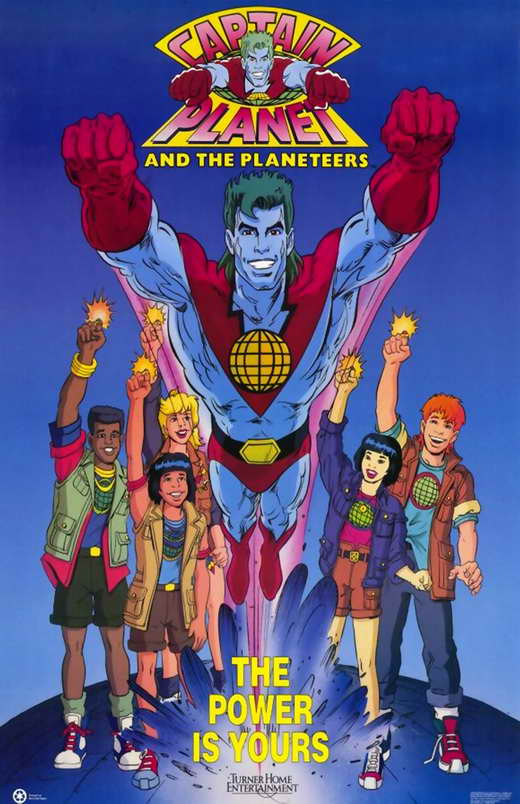
How Captain Planet Taught Me to Write

Hindsight is a great thing. So, I suppose, is patience and the ability to wait. When it comes to writing, or being a writer, there's a very direct link; stories and the writing in them always look worse in hindsight, and get better if you wait before you edit.

Writing always looks worse in hindsight - there's a lot in that statement. If you've written something, then it's OK to be proud of it. Heck, if you finish a book, it would be odd not to be proud. And even if you know it's not perfect, you think you're getting somewhere. There are even scenes, or sentences, or particular phrases, that are pretty damn good. You're not half bad at this. You can write! You're a master!

But take that writing, leave it - ooh, a couple of weeks? A few months? - and go back to it. It's not pretty. It's like rewatching an old cartoon from your childhood and seeing the horror, the cliche, the nonsense of the stories in all their garish 1980s glory.


I loved Captain Planet as a kid. I couldn't see anything wrong with it. Heroes from all over the world uniting through awesome magic to save the earth and beat the bad guys! Yeah!

I watched an episode with some friends when I was at university. Bad Idea. The inane stories, the cheesy, throwaway characters, the morals crowbarred in to the episodes - oh, man. We swore off Captain Planet and preferred to keep our childhood memories alive.

And why was there never a European there, either? And ... Power of Heart? Please. Everyone knows that was the worst of all the Powers. Pff.

Anyway - we looked back at something that had been so good in our minds and had turned out to be so bad. Writing can do that. Going back to read stories I wrote and just staring in mute horror at the sheer levels of ineptitude isn't exactly an ego booster, but it does help those stories get better, in the end. When you can see flaws you can fix them. If you're too wrapped up in the moment, you tend to lose sight of the point of what you're doing. It's not just to get the story down, it's to do it in a way that's readable.

And also not to waste time watching old cartoons. It doesn't end well.

1.29.2013

The Madness and Brilliance of Writing

Writing's a funny game. You make things up, put 'em down, and then hope other people will want to pay to read them. If it all works out, you make enough to get by. Even if it doesn't, you've been validated. Your stuff was good enough to get out there, to be read and liked (by some). To matter.

Like anything, as time's gone on, it's got more and more complicated. Authors used to write their books. Now they have media appearances and Twitter (and blogs) and need to understand marketing, to a degree, and publicity. And with all that, there's still no shortage of people writing / scribbling / typing through the night, through stolen evenings when the kids are asleep, during lunch breaks, on grey, wet mornings before the sun's up, just to get the stories down and send them into the world.

It's not the definition of madness, but it's a certain ordered lunacy.

Of course, plenty of writers have been mad, just like plenty of artists. Maybe the excess of the mind that leads to great writing tends to make mush of other things.

But it's fun, still, to reach to make books, like so many others, and to take all the modern twists - the blurbs and the queries and the cost benefit analyses - in your stride because you still think it's worth it. Beyond all the covers and editors and submissions and seeming like you need to jump through hoops is the belief - arrogant maybe, but concrete nonetheless - that you want to write, and to have it out there, in the world, and that makes it all worth while.

It's a good belief to have, and it has to be solid as a rock to ensure that the ordered madness - the one that means you're staring at a computer screen at 3 a.m. while all the respectable folk are asleep - doesn't become just a little bit too unordered. A fine line, perhaps, between a writer and a loon.

But it's still brilliant. So keep on, type away, and tr to convince yourself that, hey, all the really important things in life happen around 3 a.m. anyway.


1.25.2013

The Three Kinds of Editing

It's been a while since I put up a 'nuts and bolts' piece, so I thought I'd remedy that today. Writing about writing (for me) tends to fall into one of two camps: the more generalized / inspirational / philosophical pieces (Why do we write? Where does it come from?), and the pickier, more technical stuff (Dialogue tags that aren't 'said' - always bad? What's so wrong with adverbs?).

And, of course, there's always the issue of editing.


Editing isn't fun, but it's where bad writing becomes good, and good writing becomes great. Nobody gets it right first time. A composer doesn't just jot down a tune and leave it at that - he works over the whole thing again and again, finding the flaws and smoothing everything over. Insert whatever further analogy you'd prefer here; the crux is that after you write, you edit, or you're fooling yourself and putting out low quality work.

So, yes. Editing. Seems to me there are three different things you're looking for in editing. For ease, and to make it seem like what I'm saying is totally true and not at all made up by me, I'm going to call them Sweeping, Sifting, and Sticky

Let's have a look, shall we?

SWEEPING EDITS

By sweeping edits, I mean just that (of course). It's a big picture, all-encompassing kind of thing. It's reading through the story, cover to cover, and seeing if the whole thing works as a single unit. It's a bird's eye view of the book, and the things it shows you are pace, narrative voice, tension, and conclusion.

Pace is easy. When writing, you take sections at a time, then stitch them together. Read the whole thing, as a sweeping edit, and you might be surprised. Does hardly anything actually happen for the first 200 pages, and then everything important in the last five? Or were you so excited when you started that you swept through the opening and the character introductions, and now they seem rushed and too thin?

Narrative voice here means checking for consistency. A novel of more than 30-40,000 words means you probably wrote it over a couple of months, at least. Things chance. The last chapters especially, where you've gotten comfortable with the voice you're in and know how it should sound, can end up very different to the more hesitant opening lines. Seeping through. Does it morph and change? Sometimes that's OK, if the plot requires it. Does it seem odd? Edit.

Tension goes along with pace. Something needs that happen that's not in the final chapter to keep people interested - this is the hook that agents and editors want. Except there has to be more than one in an entire book. Are enough things happening for people to be invested right through to the end - remembering, of course, that unlike you, they don't know there's a satisfying ending coming, and they need to inspiration to continue.

Conclusion? Well, it's the end. It's the end of all major things, though - not just one. Have all the questions you raise throughout the entire book been answered? Are the characters all accounted for? You'd be amazed how easy it it to completely forget about Stanley, the lovable but haunted postman, who you had wander into the woods in chapter five and forgot about. Readers probably won't forget. Where did he go? Conclude!

SIFTING EDITS

We're coming down from our bird's eye view now to look at what actually happens per page. It's time to take narration, dialogue, exposition, etc., and see how your writing actually holds up. Look for clunky phrasing, speech that would never sound natural if it were actually spoken, word usage, and paragraph breaks. Particular turns of phrase that seem so right, so genius in the early hours of the morning, on your fourth coffee and your ninth whisky, may shock you into a rude awakening when you read them a few months later. Did you write that? Really? Why? Kill it.

Speech is a hard one. Dialogue has to be natural enough that people don't think it sounds forced or robotic, but filled with meaning, and not just filler, or editors themselves will wonder why it's there. Try reading it out loud, if you don't feel silly. Make sure you didn't use characters names too often - in real life conversation, how often do you use friends' names when you're addressing them? And remember that people rarely get through three or four sentences without someone interrupting. It's not rude - it's how conversation flows. Character who get to monologue in a book are being too forceful and it's your job as much as other characters' to cut them down a bit.

Sifting edits is a good time to make sure you're not either using the same word over and over, or using words that are a tad incongruous in their setting. I have no problem with adverbs - some do - but there still has to be a limit before the reader gives up and drowns, lost to despair. Make sure words work for you; the right one, in the right place, at the right time.  After this, you can look at things like paragraphs, chapter breaks, etc. The book should flow, with changing scenes and locations easy to follow.

STICKY EDITS

Not the 'I dropped my jam sandwich on my manuscript' kind - though that would need dealing with. No, this is the least fun of them all, sadly. It's punctuation, grammar, spelling, consistency checking, and fact checking.   Ones where you need to get stuck in.

Go through your book with a fine tooth come, and find those tiny, annoying things, and fix 'em. The good news here is that there is a right and a wrong answer. Unlike voice, or tension, where you need to feel it, and treat it as art, these sticky edits are objectively correct or incorrect. Commas work a certain way. Colons do, too. If you're using ' or " to mark speech, be consistent. Don't change halfway through. Ditto place names, or the weather. If you start the novel in winter, forget that, and have a character in the next scene in shorts, you've slipped up. If they need to travel to London, hop on the train, and it takes half an hour from Edinburgh, you've slipped up. (Some would say if you're writing about Britain and the trains work at all, you've slipped up, but let's not go there right now...)

Fact checking's on you, too. Is the capital of Portugal really Barcelona? Seems suspect. Can you really buy a house in cash? Would that will have been publicly available the day after she died? These things can matter. Things that happen unrealistically only for the sake of plot - because the plot needs them to, with no discussion about it - can be a mark of lazy plotting. Lazy writing isn't worth people reading, a lot of the time. Make sure you world is complete and works within its own rules.

So, yes. Some ways of editing. Some will work for some writers, others won't. The key, though, is that writing gets better the more you polish it.

And who doesn't want better writing?

SPC

1.23.2013

Wednesday's Inspiring Books

It's been a while since I did this, but it's Wednesday, and I have some spare moments, so the moment has come round once again. Wednesday's Inspiring Books is meant to be a list / celebration / record not just of my favourite reads, but of the books I read when I was younger that inspired me to become a writer myself - those books I still remember reading with a mixture of excitement and jealousy that some people, somehow, got to do this for a living.

Today's book is NORTHERN LIGHTS (or, THE GOLDEN COMPASS) by Philip Pullman.


My younger bibliophile sister owned and read this book before me, and perhaps it was the cover, or the satisfyingly heavy feeling, but even without knowing too much about it I was intrigued. This is one of those books where I can remember to the exact spot and position I was in when I first read it. From the very first line -  which, by the way, deserves to become one of those oft-quoted and well-known opening lines (a la REBECCA) - this book draws, drags, and whispers you in to another world and another way of thinking. I can't decide if it's a sad distraction or a worthwhile talking point that this trilogy got bogged down in theological argument on and off page, but for kids, those things don't matter anyway. The images, the characters, the amazing world building and terrifying odds - that's what mattered, what still matters, and what  makes this book a keeper for me.

I ended up doing my bachelor's dissertation on Milton's Paradise Lost, and I wonder if that's due in no small part to Pullman's association of the poem with this book. Possibly. Probably. Either way, NORTHERN LIGHTS manages to balance genuinely insightful and clever concepts with story telling and action enough to keep anyone hooked. Pullman's definitely one of those writers to use if you ever want to challenge the view that lids books should be easy, or simple, or patronize the reader.

As for that opening line ...


Lyra and her daemon moved through the darkening Hall, taking care to keep to one side, out of sight of the kitchen.


And that's what I have to say about that.

SPC


1.19.2013

AW January Blog Chain - Thirteen / The House


The House

There was a thirteenth month.

Not that he was ever invited. It had been agreed, long ago and by some common consent, that he would stay away. It was best for all, it was thought. Especially for the young ‘uns.

‘He's trouble,’ said December, rough and old, his beard of twigs. ‘Mark my words. Best kept away. Hmph.’
‘Oh, yes, pet,’ said September, a thin, skittish woman in a pale blue dress. Her arms, covered in silver bracelets, always seemed too thin, somehow. 

October grunted. He rarely spoke. June and July giggled in the corner and whispered, their shoulders bare and shaking as they gossiped. They were young and silly, easily offended

‘You know, he might come this year,’ said February. He blew smoke across the room, white tendrils in the sunlight. Eleven faces turned to him. He shrugged and stubbed out his cigar.
‘What? What’s that?’ said December.
‘I heard rumours. He might come, is all.’
April smiled. January slapped her hand. 
‘And how would he know where to come?’ asked December. ‘Pah. Rubbish!’

February nodded, just once.

‘He could,’ said November. ‘If he wanted. You think he couldn't?  The House of the Meeting of the Months – that’s what this place is. Don’t forget the old names. And he is a –‘
‘He’s not,’ said March. ‘He left, long ago.’

October clicked his tongue.

‘You see?’ said December. ‘Trouble. Even when he’s not here he’s upsetting the order and the young ‘uns and … and things.’
‘You’re so right, darling,’ cooed September. 

They were silent, those who had come to the House. Outside a bird sang. Outside a car raced. 
‘In my land,’ said August, placing an empty glass of scotch on the table, ‘I heard whispers. That he is moving. That he’s back.’
‘And what land is that, love?’ asked September, smiling, showing teeth. She winked at April. Her bracelets jingled as she moved. 
‘Don’t patronize me…’ said August.
‘Oh, I’m just having a bit of fun,’ said September, holding up her hands in mock surrender. ‘You have a very nice land, so full of … well, whatever the weather’s like in August.’
‘You know full well what August is like,’ said January. ‘Intolerable woman.’
‘Oh!’
‘Well, you are.’
‘And what is January?’ spat September. ‘Blandness and new nothings! Oh, yes! Very nice, I don’t think.’
‘Quiet!’ said October in a voice of smoke and iced. The room was silent. 
‘He’s here,’ he said, and he turned away, bored.
The door knocker sounded, once, twice. June whimpered. February laughed. 
‘So he’s really here,’ said March. ‘He’s still alive, after all.’
Outside, someone scuffed their feet.
‘Hmph!’ said December. ‘Thinks he can just –‘
‘You have to open the door,’ said someone, and afterwards no one could quite say who. ‘You know the rules. He found the House. That gives him the right. He has to come in. The right of entrance. You know that.’

There was the just the slightest of pauses.

'Yes,’ said December. ‘Yes.’
Even he would never question this. Some rules change, can be questioned, can be broken. Some do not, cannot, must not. He grasped the handle, a well polished brass, turned golden by years – by centuries -  of use. The door swung open. The man stepped in. 

There is a thirteenth month.

For some there always has been. 

*****

Other writers in the chain:

orion_mk3 - http://nonexistentbooks.wordpress.com (link to post)
Ralph Pines - http://ralfast.wordpress.com (link to post)
SRHowen - http://srhowen1.blogspot.com/ (link to post)
areteus - http://lurkingmusings.wordpress.com/ (link to post)
angyl78 - http://jelyzabeth.wordpress.com/ (link to post)
Amanda R.: http://www.twoamericansinchina.com/ (link to post)
randi.lee - http://emotionalnovel.blogspot.com/ (link to post)
ConnieBDowell - http://bookechoes.com/ (link to post)
writingismypassion - http://charityfaye.blogspot.com/ (link to post)
Briony-zisaya - http://fantasywriterwannabe.blogspot.com/
Kewii - http://kellyneeson.blogspot.com/
katci13 - http://www.krystalsquared.net/