5.25.2012

WYy its importe nt to always edIt your work."

Yes, the title is a joke. Come on, now. 

Editing is often seen as the bane of a writer's life. If writing is the joy and the creativity, editing is somehow the dull counterpart that's more of a slog through a grammar book than any sort of artistic expression.  It's like firing a kiln when throwing a pot is finished. Or framing a painting? Anyone with the know-how can do it.

Wrong, of course. Yes, editing is in part about catching typos and mistakes and pointing out grammar use, and it is also, in part, about editing plot and character and pointing out that they had Christmas twice in a week or that a character walked out of a room, came back in, and came back in. It's easy for a writer to lose track when they're focusing on the big picture over several months of writing. 

But editing is more. If it were only a matter of grammar and punctuation, then anyone could do it if they knew the rules.Why is it not? Because it's a part of the creativity itself, and a writer should edit their own damn work. Want the analogy back? It's like drawing the outline and getting someone else to just 'fill in the colours.' That's not painting as it should be. 

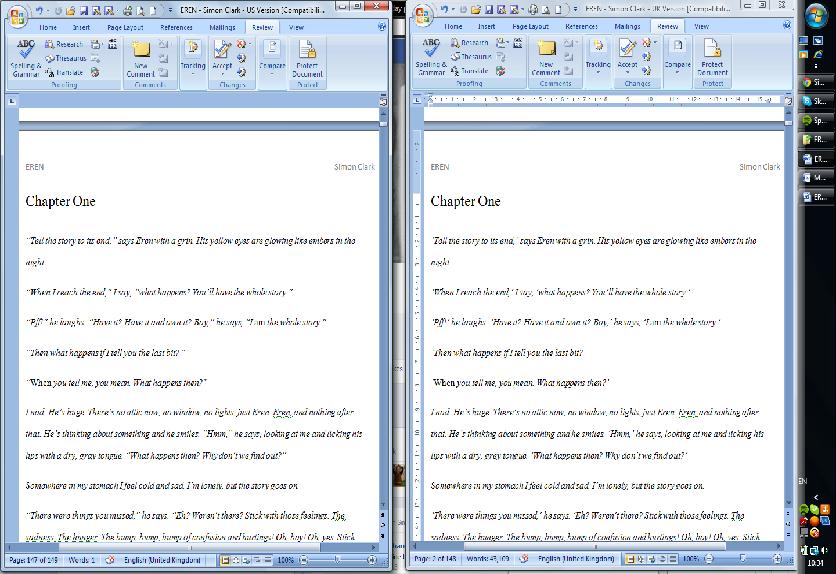
Done, UK- and US-style.

When I edit I'm looking for style and phrasing and taking another chance to go over the whole thing and improve it. I like to - to tinker with the whole thing again. Take another shot. Once it's out there and you've sent it off, you can't take back what you said...


5.23.2012

Wednesday's Inspiring Books

With recent busy-ness and other distractions, I've missed this for a couple of weeks. A gradual return to normality now seems called for, so without further ado, let's get on with this Wednesday's inspirational book.

Harry Potter and the Philosopher's Stone (Book 1)
That's right - it's the original British cover. None of your fancy re-releases. Gerrof my land! 

In many ways it's an obvious choice for any blog about children's literature over the past few years. J.K. Rowling has been credited with inspiring a whole generation to turn back to books, with redefining what children's literature can be, and with breaking down the children's / adult's literature dichotomy. 

They're great books - don't get me wrong - but it's not all of that I want to focus on. Instead, in the spirit of this blog feature, I want to share, just quickly, how Harry Potter and the Philosopher's Stone influenced me. 

I'm not sure how long the books had been out when I read them. They certainly weren't the huge success they were to become. The fourth book definitely wasn't out. Possibly the third one was only just being noticed. I found a copy in the house that belonged to my little sister, and I have vague memories of being told the book was quite popular. I read it, and thought it was good, and I decided to find out more about the author. 

That was my introduction to the whole world of authors and books and publication and that people sat down, struggled, and wrote these things. As media attention grew and focused more and more on Rowling, I came to discover one thing - being an author was an actual job you could do.

I promise you, it wasn't the fame or the money that made this one book turn my head. It was finding out, in and of itself, that writing was a choice and anyone could do it, if they wanted. It was off the back of this that I wrote my first ever novel (A terrible book which, I pray, never sees the light of day).

Writing one book turned into two, which turned into three, which led to buying The Writers' and Artists' Yearbook and making first contact with an agent, and learning the ropes, and honing craft. Which all leads up to the here and now, of course. More learning. More honing. More writing.

So that's today's story. Books change people who read them, and if you're lucky, it changes you for the better, and in a way that will be felt for years and years to come.

5.21.2012

EREN prepares for launch

It's a weird experience, sharing work. This blog was originally started to try to break me of the habit of being secretive and coy about my writing. I'd say it's done a good job so far. Getting out there, on Twitter, on Facebook, in the world at large, certainly helped me get signed to an agent - but it's the contacts I've made that matter just as much. Other bloggers, Twitter-ers, general readers - the community, I suppose, of writers. Being more declarative about writing is always good.

EREN is approaching submission to publishers. We're in the last stage of edits now. I'm changing all the single quotation marks ( ' ) to double quotation marks ( " ) for the American version, along with spelling and word choice and, at times, idiom. It's been line-edited and gone back and forth between me and Molly several times. It's been formatted into a lovely sans serif font.

And then editors are going to read that. Isn't that strange? It's a terrifying thought. It's a brilliant thought. That EREN might be taken seriously and considered by real people, as a real book, is still completely bizarre to me, even if it is what I've wanted for so long.

But that's where we are. I wrote a short bio of myself in third person to go with the pitch, and Molly is deciding which editors and publishers to approach on both sides of the Atlantic.


And now, a big shout out to my stupendous wife Ashley, who bought me a pipe, that I could be a Real Writer. What an awesome gift.


5.18.2012

Practical 'How Do I...?' Publishing Stuffs

A more practical post today, following on from my thoughts and experiences of writing a novel and what goes into a book.

I've written a few books over the past 10 years or so, and in that time I've been learning about publishing, about what writers can do to help themselves out, and about the basic, professional standards in the industry. Now, I lived, studied and worked in England for the majority of this time, so this advice is UK-specific, but I'll mark US-equivalents where necessarily.

This all applies to novel-length fiction, by the way.

So.

You've got to write a book, first. Surprisingly, this isn't something everyone knows or does. Literary agents (of which more below) and publishers do get approached by prospective authors or with a 'pre-query' (which is not a thing) but all that does is show you haven't understood how the system works. Non-fiction is different, but that's not my field. Fiction is, and in fiction, you gotta write. So, write your book, and revise it, and make it as good as you can. Only then move on.

Written it? Great! Congratulations. You're already doing better than most. Starting a book isn't the same as writing a book. Awesome.

You can approach a publisher directly, but this is almost always going to lead to a form rejection. In today's world, most editors are simply too busy to take on un-solicited manuscripts (mss.) Un-solicited in this case means 'not requested,' and any mss. sent in like this go on the slushpile, or the stack of books waiting to be read and / or responded to. I'd avoid publisher submissions for now, and instead aim for a literary agent.

And here's the first link - you need to buy The Writers' and Artists' Yearbook. Published annually, it lists all the agents, publishers, and everything else you'll need, along with explaining how to write to them, complete with samples, advice and pretty much anything you could need to know. (The US equivalent would be The Writer's Market. Both this and the Yearbook are available in most bookstores)


The 2013 edition will be out very soon. Read through it, see what agents are accepting your genre, and do what the books say, exactly as they say. Professional writing needs professional approaches. Literary agents will be able to submit your ms. to publishers - the normal rules don't apply here, if you like, and they have a more direct line to the editors. Most of them are friends, or colleagues at least. They add professionalism and gravitas to your submission, and you pay them with a cut (15% is normal) of any money you make. Go on their websites and follow their guidelines. You have been warned.

Here's my second linky! Getting an agent itself is hard, with competition from other writers far outstripping the amount agents can handle. How can you give yourself a boost, keep up to date, learn the best practice and get great advice from those in the know? Get involved in the writers community on the Absolute Write Forums.  It's invaluable, I promise you. Your query and submission will be better, you'll be more informed, and you'll be happier for it all.

Once you're submitting, I recommend Query Tracker as the easiest way to keep up with who else is walking the same path as you, agent response times, and agent moves.It's free and pretty easy to use. Response times tend to hang around the three month mark, so try not to go crazy, and keep busy. Start your next book, for one thing.

Through all of this, keeping up with the latest book news is a good idea, since you want this to be your profession. The Guardian Books site, for all its flaws, is one of the best I've found. See what's happening to authors you know, in the industry at large, and learn about the newest trends.

And finally - what do good writers do? Read! Read widely, in your own field and outside of it. Read the latest prize winners and best sellers, and then read whatever else you want to. Reading is learning, I guess. Learning craft and style and words you can steal later.

It's hard, but the part where you write and read should be fun. Remember that most of all. If you're not enjoying it, what's wrong? Are you isolated, or have you misunderstood what to expect? Turning a hobby into a living is never easy, and if you don't have a love of writing for writing's sake, that could be a indicator of trouble to come. Stay positive!

And that, for now, is it. Do you have any other links or tips to share? Let me know in the comments below - I'd love to keep learning more myself.

5.16.2012

Writing, Finishing and What Books Really Are


It’s been a fun week, feeling all accomplished and happy, feeling that being able to use the phrase ‘I’ll talk to my agent’ is a Big Step. With EREN now going through line edits, and submission to publishers now very much a reality, it’s tempting to sit back, and think of that book as done. Except books are never really done – ask any writer you know. They get finished, and sometimes published, but there’s always tinkering to do, always things you missed out, or feel you shouldn’t have put in. Reading through EREN, even knowing I made it safe and onto an agent’s books, I still feel awkward. Did I write that? Why? That word’s a bit off. I shouldn’t have made him say that…

Books do get rereleased, of course, and sometimes authors are lucky enough to get a second chance. Mostly, though, the book has to be good enough in the writer’s eyes, even if it’s just plain old good to everyone else.

Now comes the switch, though. I feel like I’m at the end – a complete book! Edited and polished and minding its p’s and q’s! I have made it!

Taken with instagram
Eren, Eren and agency contract in a big pile of happiness, avec stylish clips

So where’s the next book?

There has to be another. If this is my life, where are the next few books?

The answer’s pretty simple. They’re in my head. It’s just getting them down on paper that’s the tricky part.

So I’m back at the beginning, in a way. And that’s brilliant. It’s exciting and frustrating and so, so rewarding to be working once more on a book which is raw and untamed and doesn’t make sense. New characters, new worlds, new feelings to write down. And everything I finish makes me better at writing the next stuff.

I’ve come to think, over the years, that books are like machines. They work like clockwork, I suppose, or like a great, hulking steam engine. There are different parts – dialogue, voice, tone, person, tense – that you have to understand to make them all fit together. You have to tinker and stand back, blowing your cheeks out, and saying ‘Well, that doesn’t work, does it? Wonder what happens if I do this…’

It’s writer as mad scientist and expert mechanic. It’s writer as engineer and handyman and inventor. Why doesn’t this character work? Here, try a No. 2 screwdriver and move his introduction to the third chapter. The writing is clunky and making a strange, pup-tang noice. Change it to the first person. Better?

©2009-2012 ~SystematicChaosInc


Books are complicated things, in the end. They need watching over and taking care of, or, when you start them up and read them, they fall apart - or worse, don’t do anything. Just sit there, big empty piles of cold nothing, and you sit back and go, ‘Oh. I thought it was supposed to roar into life. Do you think I should have put this screw in?’

The best machines work amazingly and you can’t tell it, of course. A tiny white box that barely purrs and glows gentle colours, and it’s actually controlling all the phone lines in a city block. Books can be like that, too. If you don’t realise it’s writing, well then, that’s good writing. All the gunk and the innards and the workings of the beast are hidden deep beneath the pages, where only the author should look. Lift up the hood of a car, and most people can tell you just about where the oil should go.  Goes for books. Authors should learn the craft, so they can fix things when they’re not working.

So I'm putting together a new book now, forcing the pieces together when they resist, banging and clattering and making a fine old mess and hoping - just hoping - that something pretty awesome rolls out at the end.